SMP vs a Standard Tattoo: Why Dermal Depth Decides Everything
The difference between scalp micropigmentation and a standard tattoo is not the design, the machine, or the artist's portfolio — it is three linked engineering choices: how deep the pigment goes, how large the needle is, and how much ink each pass delivers. A standard tattoo is built for saturation and accepts the consequences: deep penetration, large needles, a high ink load, and an accepted risk of migration and bleed. SMP is built for optical separation: a 3R-SR micro-needle, the upper dermal layer only at 0.3–0.5 mm, roughly 250 deposits per cm², and zero intended migration. One method is designed to blur into a field; the other fails the moment it blurs.
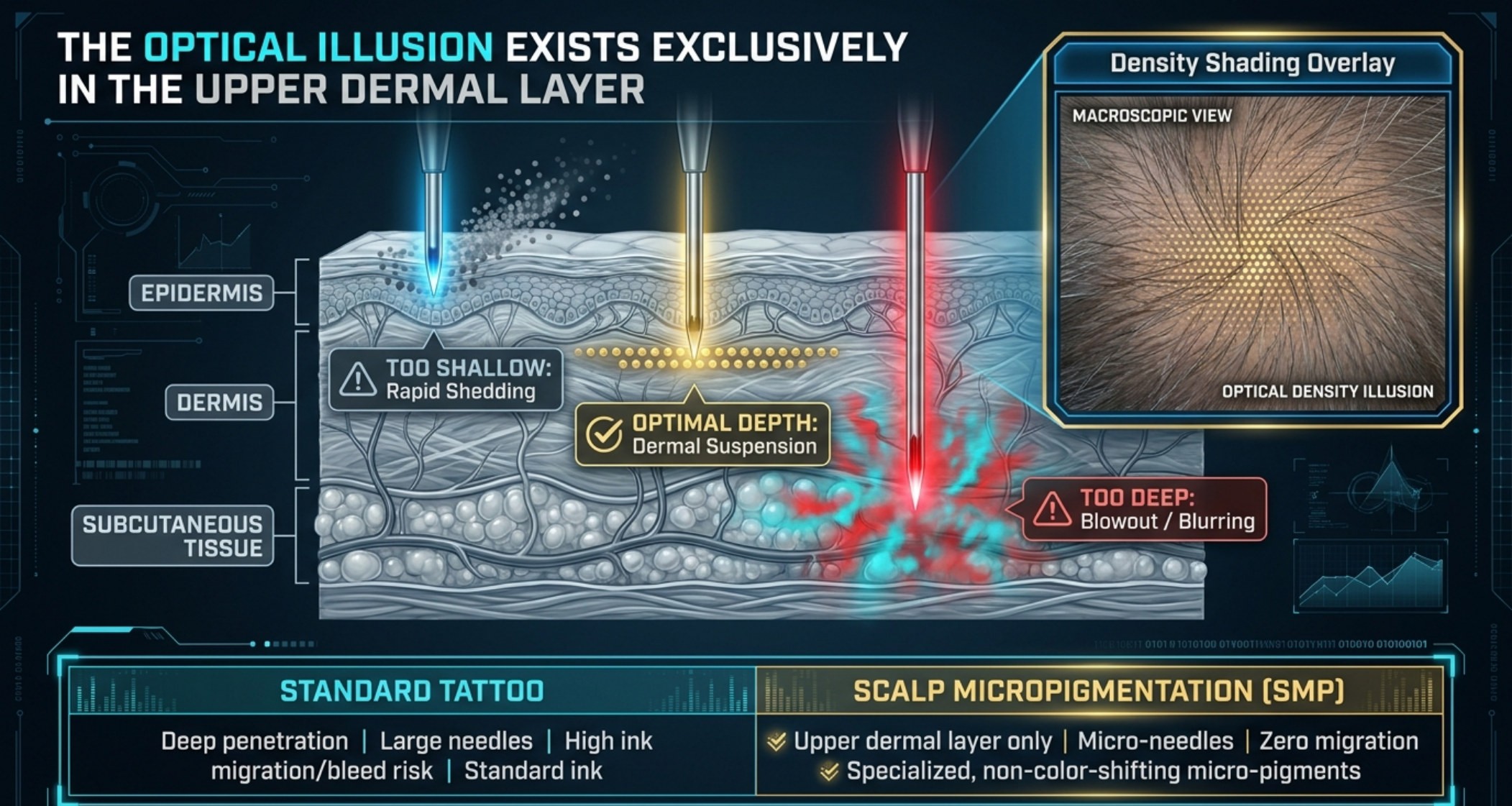
That single inversion explains why a tattoo artist cannot simply switch technique and produce SMP. Everything that makes scalp work read as hair — the circular micro-dot, the visible gap between dots, the sharp edge of a hairline — depends on keeping pigment suspended in the dermis rather than saturating it. This is educational information, not medical advice, and a qualified provider should assess the individual case.
The short version
- The difference between SMP and a standard tattoo is three linked engineering choices: how deep the pigment goes, how large the needle is, and how much ink each pass delivers.
- A standard tattoo is built for saturation with deep penetration, large needles and a high ink load, and it accepts migration and bleed as the price of coverage.
- SMP inverts each of those choices with a 3R-SR micro-needle, upper dermal placement at 0.3 to 0.5 millimeters, roughly 250 deposits per square centimeter and zero intended migration.
- The useful window is a 0.2 millimeter band inside the 0.3 to 0.5 millimeter target, so depth cannot be averaged: too-deep pigment cannot be retrieved and re-dotting a blurred area enlarges the blur.
- SMP uses specialized non-color-shifting micro-pigments rather than standard ink, and the deck ties MRI interference to iron oxide traces in substandard pigments.
- Success is judged by contrast rather than darkness, so touch-ups restore contrast by re-dosing faded areas instead of adding density to the field.
The Three Layers, and What Each One Does to Pigment
Pigment placed in the epidermis is too shallow: the layer renews continuously, and deposits are shed at a rate that makes the field unstable rather than permanent. Pigment placed in the subcutaneous tissue beneath the dermis is too deep: it disperses through soft tissue, and the crisp micro-dot the technique depends on becomes a soft, diffuse cloud — the failure mode the deck labels blowout or blurring. Only the middle destination works. In the upper dermal layer, pigment is held in what the slide calls dermal suspension: deep enough that the body does not shed it, shallow enough that each dot keeps a defined border.
Because the useful window is a 0.2 mm band inside a 0.3–0.5 mm target, depth is not a setting that can be averaged. A tattoo machine set for saturation will overshoot it, and a hand trained on decorative work has no corrective move: too-deep pigment cannot be retrieved, and re-dotting a blurred area enlarges the blur. The only protection is to place the deposit correctly on the first pass, which is why SMP is measured in fractions of a millimetre rather than described in terms of shade.
| Layer | Outcome | Why |
|---|---|---|
| Epidermis | Too shallow — rapid shedding | Continuous surface renewal |
| Dermis (upper) | Optimal — dermal suspension at 0.3–0.5 mm | Held, but not shed or spread |
| Subcutaneous tissue | Too deep — blowout / blurring | Dispersion through soft tissue |
Standard Tattoo Engineering vs SMP Engineering
Set the two specifications side by side and the intent of each becomes obvious. Standard tattooing optimises for permanence and coverage, so it uses deep penetration, large needles, and a high ink load with standard ink; migration and bleed are understood costs. SMP optimises for legibility and reversibility of appearance, so it constrains penetration to the upper dermal layer, works with micro-needles, and specifies specialized non-color-shifting micro-pigments. Every row of the comparison is a deliberate rejection of the tattoo default.
The material choice deserves its own emphasis, because it is the one most often substituted. Standard tattoo inks are formulated for a saturated field and are expected to sit deep and stay vivid. SMP micro-pigments are formulated to stay where they are placed and to resist the colour shift that turns a warm-brown dot into a blue-grey smudge over time. Substituting a conventional ink does not lower the cost of the session by much, but it changes the failure mode from fading to colour drift — and the deck ties MRI interference to iron oxide traces in exactly those substandard pigments.
| Variable | Standard tattoo | SMP |
|---|---|---|
| Penetration | Deep | Upper dermal layer only |
| Needle | Large | Micro-needle, 3R-SR gauge |
| Ink load | High | Controlled, ~250 deposits/cm² |
| Ink chemistry | Standard tattoo ink | Specialized non-color-shifting micro-pigments |
| Migration risk | Migration / bleed accepted | Zero intended migration |
Why Blurring Is a Failure SMP Cannot Afford
A tattoo's success metric is a continuous field of colour; a scalp treatment's success metric is the opposite — thousands of separate dots with visible gaps, because the eye reads gap-and-dot as follicle-and-skin. This means the two methods fail in incompatible ways. A tattoo that spreads slightly still reads as a tattoo. An SMP field that spreads slightly stops reading as hair and starts reading as a solid stain, and there is no pigment-side fix: the deposit is already dispersed below the layer that would hold it.
The practical test is therefore contrast, not darkness. A well-built field at 250 deposits per cm² stays legible because the dots do not touch; a denser pass does not increase realism, it reduces the gap that produces the illusion. That is also why maintenance works the way it does. Rather than adding density, touch-ups restore contrast by re-dosing areas that have faded, which is why the deck reports 7 to 32 months of tracked longevity with minimal fading when the schedule is followed.
Depth Discipline in Practice: Gauge, Density, Session Load
The clinical numbers are the same for every client and the discipline is to respect them. Depth is fixed at 0.3–0.5 mm, gauge at 3R-SR, density on the order of 250 micro-deposits per cm², and each session runs 2–4 hours. Work is staged rather than compressed: a baseline session, then sessions at +1 week to build density, then a touch-up at 1 month once the skin has settled enough to judge the healed result.
The staging exists because depth and density interact with healing. Judging a field on the day it is drawn overstates how dark it will remain, and adding the next pass too early stacks trauma onto tissue that has not finished settling. For a Bellevue client weighing scalp micropigmentation against a surgical route, the honest framing is that SMP is a pigment-and-geometry treatment and a transplant is a tissue-supply treatment; they solve different problems, and the side-by-side comparisons lay out where the boundary sits.
| Constant | SMP value | Tattoo default |
|---|---|---|
| Depth band | 0.3–0.5 mm | Depth chosen for saturation |
| Deposit density | ~250/cm² | High ink load |
| Session length | 2–4 hours | Scales with coverage |
| Maintenance | Touch-up cadence; 7–32 month window | Rarely touched up |
Vetting: What a 0.3–0.5 mm Standard Demands of the Operator
A depth band this narrow shifts the risk from the product to the practitioner, so the vetting questions are specific. The deck's framework requires a medical or dedicated cosmetic setting rather than a standard tattoo studio, documented sterile single-use micro-needles and fresh ink cups for every session, and exclusive use of specialized non-migrating SMP pigments. On experience it sets a floor of more than 1 year of SMP-specific work with a verifiable clinical portfolio, backed by active certification and continuing education aligned to SPCP or equivalent medical board standards.
The reason those requirements exist is the risk profile. The deck's dashboard grades pathogen exposure — triggered by unsterile equipment — as high severity, and treats keloid formation as a contraindication for genetically prone individuals. Against that, allergic reactions are graded low probability but still require patch testing, and MRI interference is graded low probability and tied to iron oxide traces in substandard pigment. Together they explain why a patch test and a sterile kit are the two cheapest risk controls in the process, and why a provider serving Bellevue and the wider Washington market follows a safety checklist that raises both before the first pass rather than after.
Frequently Asked Questions
Is SMP just a tattoo on the scalp?
No. A standard tattoo uses deep penetration, large needles, and a high ink load with standard ink, and accepts migration and bleed. SMP uses a 3R-SR micro-needle in the upper dermal layer only at 0.3–0.5 mm, with zero intended migration and non-colour-shifting micro-pigments.
Why does depth matter more than shade?
Because the only useful destination is the upper dermis. Shallower deposits shed rapidly from the epidermis; deeper deposits disperse in the subcutaneous tissue and blur. Only the 0.3–0.5 mm band holds pigment without shedding or spreading.
How long does a scalp field hold, and how is it maintained?
The deck reports 7 to 32 months of tracked longevity with minimal fading, maintained by touch-ups rather than by adding density. Sessions run 2–4 hours, staged at +1 week with a touch-up at 1 month.
Get matched with hair restoration professionals →
Ready for a Professional Review?
We can connect you with qualified hair restoration professionals who can map your situation to the right treatment.
Get Matched with Hair Restoration Professionals