SMP Scar Camouflage: Rebuilding Density in FUE and FUT Donor Zones
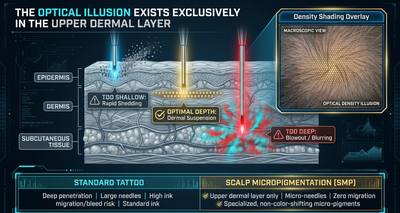
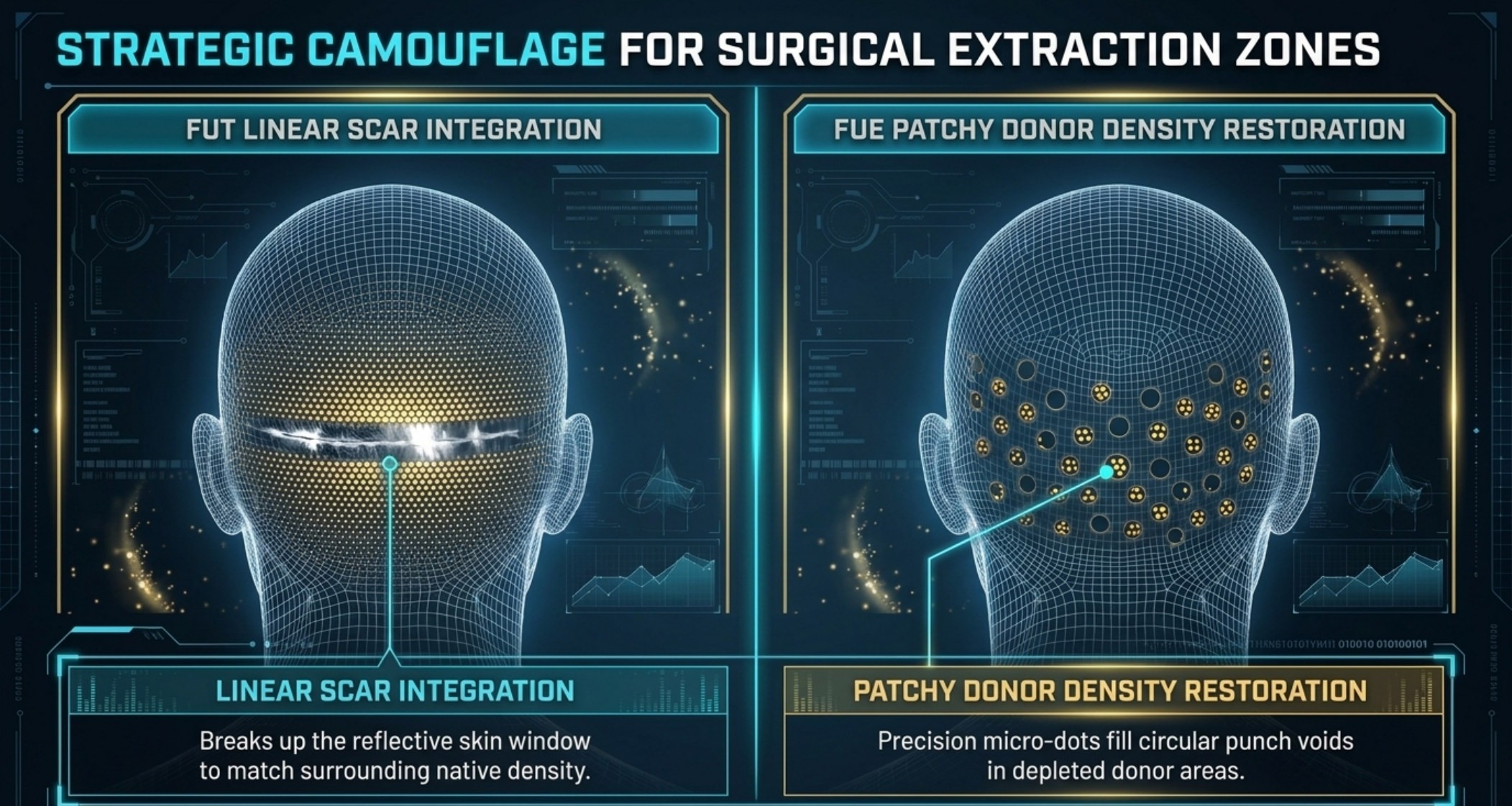
Surgical hair restoration leaves two very different donor signatures, and they fail the eye for two different reasons. A FUT procedure leaves a single linear scar; an FUE procedure leaves a scattered field of small circular punch voids. Both read as missing hair because smooth scar tissue reflects light where follicular skin would scatter it, and the deck's fix for each is a different deposition pattern: linear scar integration to break up the reflective skin window along the line, and patchy donor density restoration to fill circular punch voids with precision micro-dots matched to the surrounding native density. Depth, gauge, and density follow the same constants the rest of the method uses — 0.3–0.5 mm, a 3R-SR micro-needle, on the order of 250 deposits per cm².
The reason this matters after surgery rather than before it is that a transplant relocates follicles, it does not create them. Whatever is harvested from the donor zone is gone from that zone, and the resulting scar or void pattern is permanent. Camouflage is therefore an additive layer on top of a supply decision already made. This is educational information, not medical advice, and a qualified provider should assess the individual case.
The short version
- FUT leaves a single linear donor scar while FUE leaves a scattered field of small circular punch voids, so the two fail the eye for different reasons.
- Both read as bald because smooth scar tissue reflects light in a continuous band, the reflective skin window, where follicular skin would scatter it.
- FUT linear scars are treated with linear scar integration, distributing micro-dots along the line to break the unbroken reflective strip rather than match it.
- FUE donor zones get patchy donor density restoration, filling each circular void with precision micro-dots matched to the surrounding native density.
- Camouflage uses the same constants as general scalp work: 0.3 to 0.5 millimeter depth, a 3R-SR micro-needle and roughly 250 deposits per square centimeter.
- Each session runs 2 to 4 hours, staged as a baseline, density work at one-week intervals and a one-month touch-up, inside the 7 to 32 month longevity window.
The Reflective Skin Window: Why Scar Tissue Reads Bald
Hair does not read as hair because of colour alone; it reads because thousands of follicles break up light falling on the scalp. Scar tissue does the opposite. A matured linear scar and the circular voids left by follicular unit extraction both lack follicles, so the surface stays comparatively smooth and reflects light in a continuous band — the reflective skin window the deck names directly. The eye interprets that unbroken reflectance as a gap in the hair, which is why a scar can be narrow and still conspicuous.
Camouflage works by reintroducing discontinuity rather than by covering the scar with solid colour. Precision micro-dots placed inside the reflective area scatter the light the way follicles would, restoring the broken-up texture that reads as density. This is also why the two donor patterns cannot share one template: a line and a field of circles present different geometry, and the deposition pattern has to follow the shape of the deficit.
| Extraction method | Donor signature | Optical problem |
|---|---|---|
| FUT | Single linear scar | Continuous reflective skin window |
| FUE | Scattered circular punch voids | Patchy depletion vs native density |
FUT Linear Scar Integration
A linear scar is a single high-contrast band, which means the camouflage strategy is to interrupt it rather than to match it. Micro-dots are distributed along the length of the scar so the eye stops perceiving one unbroken reflective strip and starts reading interrupted texture, breaking up the reflective skin window to match the density on either side. Because the scar is a line, the placement has to respect the direction and width of that line; dots scattered at random density would simply create a second, softer band.
The trade-off is between concealment and restraint. A linear scar can absorb more pigment than an untouched scalp before it looks artificial, but every dot added near the boundary risks extending the apparent width of the scar rather than reducing it. That is why the integration approach is judged on healed skin at the +1 week and 1 month checkpoints rather than immediately after a pass, and why a session remains a 2–4 hour commitment even when the target area is a single line.
FUE Patchy Donor Density Restoration
An FUE donor zone is a different problem: not one line but a scattered field of small circular punch voids across an otherwise haired area. Here the goal is to fill those circular voids with precision micro-dots so that the depleted patches match the surrounding native density rather than reading as a separate texture. Because the deficits are circular, the work is a matching exercise — dot spacing inside each void has to be consistent with the follicular spacing around it, or the filled patch reads as pigment instead of hair.
This is where density discipline does the most work. The usable reference point is roughly 250 micro-deposits per cm²; pushing past it inside a small void does not improve the match, it removes the visible gaps that make the dots read as follicles. The same 0.2 mm depth margin applies here as everywhere else, and it applies to scar tissue specifically: too shallow and the dots shed before the match is stable, too deep and they blur into a stain across a void only a few millimetres wide. If you are still planning the surgery itself, the FUE recovery timeline is the relevant companion read, because donor healing determines when camouflage can safely begin.
| Deficit | Deposition pattern | Target |
|---|---|---|
| FUT linear scar | Micro-dots distributed along the line | Break up the reflective skin window |
| FUE circular punch voids | Precision micro-dots filling each void | Match surrounding native density |
Depth, Gauge and Density: The Same Constants Apply to Scar Tissue
Scar camouflage is not a looser version of scalp micropigmentation; it is the same technique aimed at a harder target. Depth stays in the upper dermal layer at 0.3–0.5 mm, gauge stays at 3R-SR, and density stays on the order of 250 deposits per cm². What changes is the tolerance: a void a few millimetres across leaves little room for a misplaced pass, and scar tissue that has not fully matured can behave differently from the surrounding skin, so timing matters as much as technique.
Staging is what makes the approach survivable in practice. The baseline session lays the field, sessions at +1 week build density without stacking trauma on the same area, and the touch-up at 1 month restores contrast once healing has settled. Longevity then follows the same 7 to 32 month window the deck reports for scalp work generally, with minimal fading over that period and touch-ups used to hold contrast. For a Bellevue patient who has already invested in a transplant and wants the donor zone to stop advertising it, that window is the planning horizon.
| Parameter | Value | Role in scar work |
|---|---|---|
| Dermal depth | 0.3–0.5 mm | Suspension without blur inside small voids |
| Needle gauge | 3R-SR | Precision micro-dot placement |
| Deposit density | ~250 per cm² | Match native density in donor areas |
| Session spacing | +1 week; touch-up at 1 month | Build density without overworking skin |
| Session duration | 2–4 hours | Scales with scar length and void count |
Sequencing Camouflage Around Surgery, and What to Verify
Timing is the variable patients most often assume is flexible, and it is not entirely. Camouflage is judged on healed skin, so the deposition schedule assumes a baseline session, density work at +1 week intervals, and a 1 month touch-up — the same cadence used elsewhere in the method because each checkpoint exists to read how the tissue has settled. Because donor tissue behaves differently from intact scalp, the practitioner needs a portfolio that includes healed scar cases, not only untouched crowning work.
The safety baseline is unchanged. The deck's framework requires a medical or dedicated cosmetic setting rather than a standard tattoo studio, sterile single-use micro-needles and fresh ink cups every session, specialized non-migrating pigments, more than 1 year of SMP-specific experience with a verifiable portfolio, and certification aligned to SPCP or equivalent medical board standards. Two flagged risks stay worth naming in this context: keloid formation is a stated contraindication for genetically prone individuals, and allergic reactions are graded low probability but still require patch testing. A Bellevue patient comparing scar camouflage with other options can work through the SMP versus FUE decision tool before booking, and see the matching process for how providers across Washington are screened on exactly these criteria.
Frequently Asked Questions
Can SMP really conceal an FUT linear scar?
Yes, via linear scar integration: micro-dots placed along the scar break up the continuous reflective skin window so the line stops reading as one unbroken strip of reflectance, matched to the density on either side.
How is an FUE donor zone treated differently?
FUE leaves scattered circular punch voids rather than a line, so precision micro-dots are used to fill each void at roughly 250 deposits per cm² to match the surrounding native density rather than a single continuous pattern.
Does camouflage use the same depth and session schedule?
It uses the same constants — upper dermal placement at 0.3–0.5 mm with a 3R-SR micro-needle — staged at +1 week with a 1 month touch-up, each session running 2–4 hours, with longevity in the 7 to 32 month window.
Get matched with hair restoration professionals →
Ready for a Professional Review?
We can connect you with qualified hair restoration professionals who can map your situation to the right treatment.
Get Matched with Hair Restoration Professionals