Scalp Micropigmentation: How the Optical Illusion Actually Works
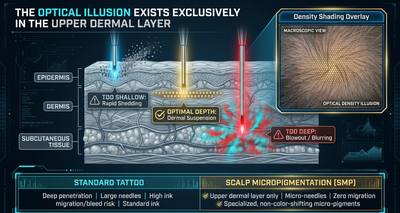
Scalp micropigmentation does not grow hair and does not replace it. It is a density-shading overlay deposited in the upper dermal layer at a band the clinical deck fixes at 0.3–0.5 mm, delivered with a 3R-SR micro-needle at a pigment density on the order of 250 micro-deposits per cm². The verdict is mechanical rather than aesthetic: land the pigment inside that band and it stays suspended as crisp stubble across the deck's tracked 7 to 32 months; miss shallow and the epidermis sheds it quickly; miss deep and it disperses into the subcutaneous tissue as the loss of definition the slide calls blowout or blurring. Most people who read this are comparing chemotherapy scalp cooling options around Bellevue, WA, so what follows sticks to the details that change in practice.

Everything downstream of that one geometric decision — needle gauge, deposit density, session pacing — exists to defend the depth band. The deck organises the whole method around three pillars a provider must satisfy at the same time: histological precision, surgical scar camouflage, and clinical safety standards. This is educational information, not medical advice, and a qualified provider should assess the individual case.
The short version
- SMP deposits pigment into the upper dermal layer at a band fixed at 0.3 to 0.5 millimeters using a 3R-SR micro-needle at roughly 250 micro-deposits per square centimeter.
- Landing pigment in that band holds it as crisp stubble for a tracked 7 to 32 months, while too-shallow deposits shed from the epidermis and too-deep deposits disperse as blowout or blurring.
- A shallow field demands another pass with more trauma and a 2 to 4 hour commitment each time, while a deep field cannot be walked back at all, which is why depth is a pass-or-fail gate.
- The method's three pillars are histological precision, surgical scar camouflage and clinical safety standards, each of which the deck reduces to a measurable number.
- The phased timeline runs a baseline session, two density sessions at one-week intervals, and a touch-up at one month, with every appointment running 2 to 4 hours.
- The safety dashboard flags five contraindication classes, grading pathogen exposure from unsterile equipment and keloid formation as high severity.
Why 0.3–0.5 mm Is the Only Depth Band That Holds
Skin presents three possible destinations for pigment, and only one of them is useful. Placed in the epidermis, the deposit is too shallow: that layer renews continuously, so dots are shed rapidly instead of settling. Placed below the dermis in the subcutaneous tissue, the deposit is too deep: pigment disperses through soft tissue and each micro-dot becomes an unreadable smudge. The middle destination — the upper dermal layer — is where pigment is held in what the deck names dermal suspension, deep enough to resist shedding and shallow enough to keep a hard edge.
The trade-off is unforgiving in both directions. A shallow field is not stable, so it demands another pass, and every pass adds trauma to skin that is already healing; each additional session is another 2–4 hour commitment and another healing cycle. A deep field cannot be walked back at all — the spread is already underway, and adding pigment to a blurred area enlarges the blur rather than sharpening it. That asymmetry, recoverable upward and unrecoverable downward, is the argument for treating depth as a pass-or-fail gate on the operator instead of a tolerance to be averaged out.
| Depth destination | Clinical result | Recovery path |
|---|---|---|
| Epidermis (too shallow) | Rapid shedding | Re-dose; cumulative trauma |
| Upper dermis 0.3–0.5 mm | Dermal suspension; holds 7–32 months | Routine touch-up |
| Subcutaneous tissue (too deep) | Blowout / blurring; pigment dispersion | No reliable reversal |
The Three Pillars, and Why Each One Is a Number
Histological precision is the first pillar because the target is a tissue depth, not a look. A standard tattoo is engineered for saturation — deep penetration, large needles, a high volume of standard ink — and accepts migration and bleed as the price of coverage. SMP inverts every one of those choices: micro-needles, the upper dermal layer only, zero intended migration, and specialized non-color-shifting micro-pigments selected precisely so that individual dots stay discrete and readable rather than dissolving into a solid field.
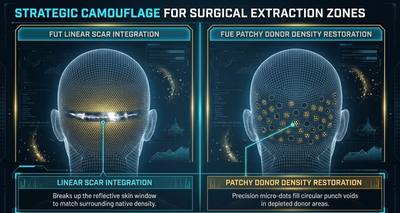
The second pillar is surgical scar camouflage, and it is the point at which the technique stops being decorative. A linear FUT donor scar and a scattered FUE donor field present two different optical problems, and the deck treats them with two different patterns. Because those patterns are driven by the geometry of the scar rather than a generic template, the operator has to be reading tissue, not tracing a stencil.
Clinical safety standards are the third pillar, and they are itemised rather than implied. The deck's risk dashboard carries five biological contraindication classes: pathogen exposure, keloid formation, granulomas, allergic reactions, and MRI interference. Two are graded high severity — pathogen exposure, whose trigger is unsterile equipment, and keloid formation, which is a stated contraindication for genetically prone individuals. Two are graded low probability — allergic reactions, which still require patch testing, and MRI interference, linked to iron oxide traces in substandard pigments. A patch test and a sterile single-use kit are not add-ons; they are the controls that move a high-severity category off the table, and they belong on every practitioner safety checklist.
Sessions, Spacing, and the Realistic Maintenance Window
A result is built in layers, not in one sitting. The deck's phased deposition timeline starts with session one to lay the field, continues with sessions two and three at +1 week each to build density without overworking a single area, and closes with a touch-up at 1 month to restore contrast after the skin has settled. Each appointment runs 2–4 hours, and the +1 week spacing is not arbitrary: it leaves room for the field to be judged on healed skin rather than on fresh, inflamed skin.
Longevity runs longer than most first-time buyers expect. The deck reports tracked clinical longevity of 7 to 32 months with minimal fading over that period, and classifies the outcome as semi-permanent to permanent cosmetics. That range is wide because the maintenance schedule is a variable, not a fixed decay: touch-ups are the mechanism that holds contrast, so the low end of the window describes a client who stops re-dosing and the high end describes one who maintains. For clients in Bellevue and across Washington, where a dense, dark, short-cropped look is common, that contrast matters more than raw pigment volume.
| Parameter | Figure | Function |
|---|---|---|
| Needle gauge | 3R-SR | Micro-dot precision |
| Dermal depth | 0.3–0.5 mm | Dermal suspension |
| Deposit density | ~250 per cm² | Optical density illusion |
| Tracked longevity | 7–32 months | Minimal fading window |
| Classification | Semi-permanent to permanent cosmetics | Maintenance expectations |
How to Judge a Result Before You Buy It
Judge the operator on the three pillars in order. Precision first: ask where the pigment is being placed and confirm it is the upper dermal layer at 0.3–0.5 mm, not a depth chosen by feel. Material second: confirm the kit is a specialized non-migrating micro-pigment rather than a standard tattoo ink, because colour shift and spread are properties of the material as much as the hand. Safety third: confirm sterile, single-use micro-needles and fresh ink cups for every session, in a medical or dedicated cosmetic setting rather than a standard tattoo studio.
Experience is a threshold, not a vibe. The deck's vetting framework asks for more than 1 year of SMP-specific experience, a verifiable clinical portfolio, and certification with continuing education aligned to SPCP or equivalent medical board standards. A portfolio of healed work at the 7–32-month mark is more informative than fresh photographs taken the day after a session, because it shows how the field has held. If you want to compare delivery before booking, the method comparisons and the plain-language SMP science and safety guide walk through the same variables from a different angle, and a Bellevue client can use both to pressure-test a provider's claims before the first pass.
| Session | Spacing | Purpose |
|---|---|---|
| Session 1 | Baseline | Lay and define the field |
| Session 2 | +1 week | Build density |
| Session 3 | +1 week | Even out the field |
| Session 4 | Touch-up at 1 month | Restore contrast |
| Per-session duration | 2–4 hours | Scheduling and cost scope |
Frequently Asked Questions
How long does scalp micropigmentation actually last?
The deck's tracked clinical longevity is 7 to 32 months with minimal fading over that period, after which touch-ups restore contrast. The technique is classified as semi-permanent to permanent cosmetics, and where you land in that window tracks how consistently you re-dose.
How deep must the pigment be placed?
The target is the upper dermal layer at 0.3–0.5 mm, using a 3R-SR micro-needle at roughly 250 deposits per cm². Shallower deposits shed rapidly in the epidermis; deeper deposits blow out into the subcutaneous tissue and blur.
How many sessions does it take, and how long is each?
The phased timeline runs four sessions of 2–4 hours each: a baseline session, two density sessions at +1 week, and a touch-up at 1 month. Spacing the density work lets the field be judged on healed skin rather than on fresh inflammation.
Get matched with hair restoration professionals →
Ready for a Professional Review?
We can connect you with qualified hair restoration professionals who can map your situation to the right treatment.
Get Matched with Hair Restoration Professionals